

Circular Economy Opens Up New Business Opportunities
PRESS RELEASE
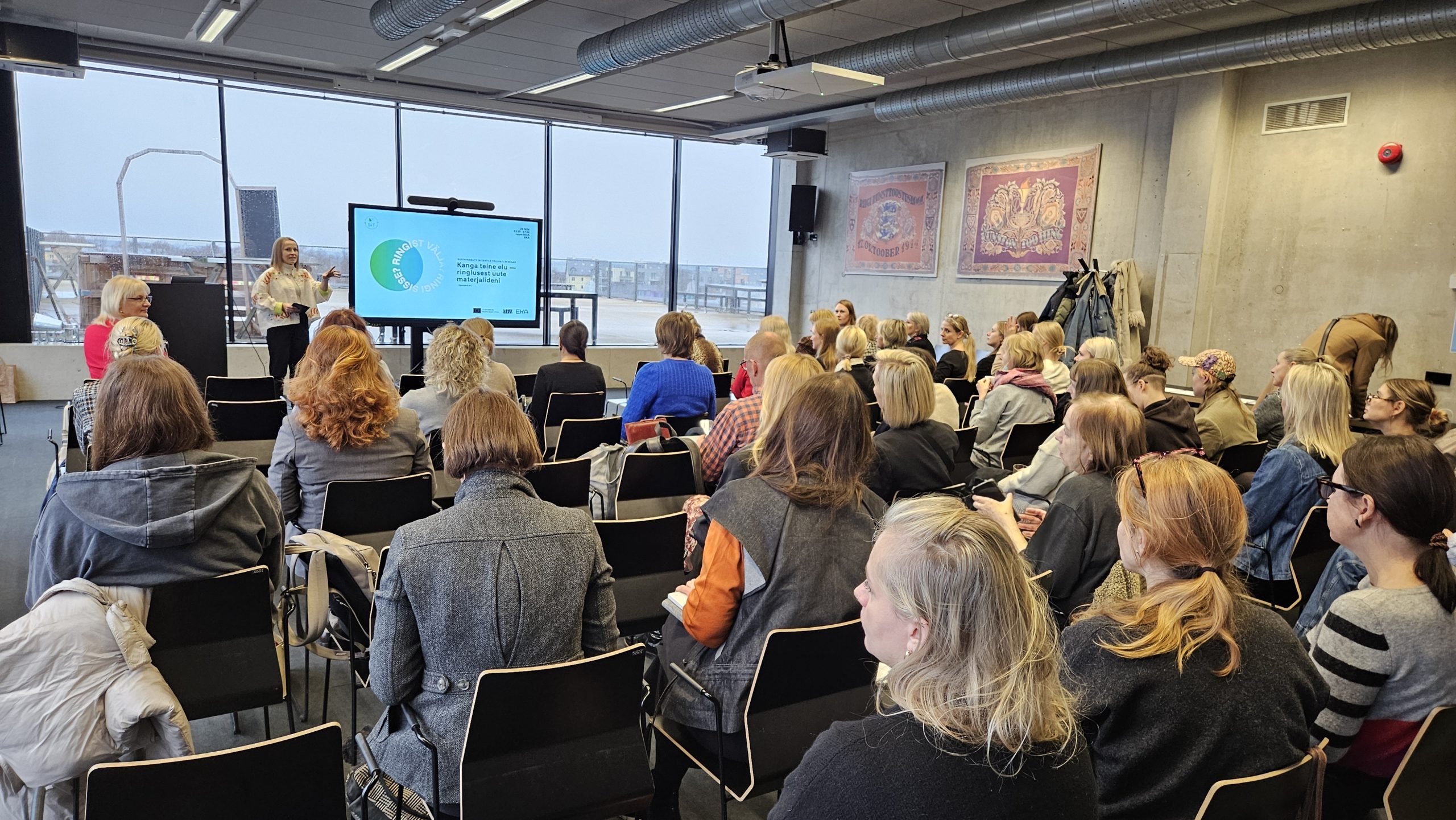
On 24 November, the Estonian Academy of Arts hosted “A Second Life for Textiles – From Circularity to New Materials”, a seminar organised by Creative Estonia and the Estonian Academy of Arts (EKA) as part of the international SiT project. The event presented the project’s results to date alongside practical circular-economy solutions developed by Estonian designers, material innovators and entrepreneurs. A central message of the seminar was that more sustainable production depends not only on new technologies, but also on knowledge, creative thinking, the ability to recognise new value in existing materials, and a willingness to collaborate.
The SiT Project Has Brought New Green Skills Learning Opportunities to Estonia
The international SiT – Sustainability in Textile, Clothing, Leather and Footwear project, funded through the European Union’s Erasmus+ programme, brings together 15 partners from eight countries. Running from February 2024 to January 2027, the project aims to support the green transition in the textile, clothing, leather and footwear industries by developing the skills needed in the sector and strengthening cooperation between educational institutions and businesses.
The project has developed two new green skills training programmes: one for Bio-Textile Technicians and another for Textile Recycling Managers. The free online courses bring together knowledge relevant to the circular economy, sustainable material use, product development and entrepreneurship.
At the seminar, Eva Leemet, Managing Director of Creative Estonia, presented the project’s results. More than 700 learners have participated in the international online courses. In Estonia, 100 learners enrolled in the training, of whom 53 completed the full course and 27 applied for an international ICEP certificate to validate their acquired skills.
Another important achievement is the creation of learning opportunities in Estonian. The SiT online learning platform will remain available after the project ends and, in addition to courses, provides an overview of European best practices and services offered by organisations in the sector.
In Estonia, Creative Estonia and EKA have organised sector-specific meetings, company visits and international learning activities.
The Value of Materials Does Not End with Their First Use
The seminar presentations illustrated the wide range of opportunities offered by extending the life of materials and adding value to production offcuts.
Sandra Luks, founder of the sustainable fashion brand LUKS, explained how discarded jeans can be transformed into distinctive garments and accessories through tearing, weaving and sewing. Her approach demonstrates that the value of design does not necessarily lie in using new materials, but in reimagining what already exists.
Material innovator Riina Õun introduced the world of biomaterials. In her experiments, by-products of kombucha production—spent SCOBY cultures—find a new use in SCOBY-compo, a material used to create fashion accessories and design products. Õun also presented eggshell-based biocomposites, including 3D-printed solutions. These examples broaden our understanding of the raw materials from which future design products might be made.
Helen Leetsar, Project Manager of EKA’s LAETUS collaboration programme, emphasised the importance of cooperation between design education and business. Small enterprises often lack the time, resources and specialised expertise needed to develop new solutions. Working with design students and lecturers brings fresh perspectives into companies and helps turn ideas into prototypes.
Anu Rajamäe and Kerly Kaljuste of KOOSdisain shared the perspective of a small-scale producer. Their work combines natural materials, thoughtful product design, collaboration and environmentally conscious production.
Repair as a New Design Opportunity
Designer and artistic researcher Marta Konovalov explored repair and regenerative textile design as ways to change people’s relationships with their clothes.
In her approach, wear, holes and stains are not simply problems to be hidden. They can become the starting point for a new pattern or design solution. Repair offers a way to extend the life of garments, strengthen their emotional value and turn people from passive consumers into active co-creators.
The Green Transition Requires Knowledge and Collaboration
The SiT project’s experience confirms that the transition to a circular economy requires education, research, design and business to work together. Practical training, company visits and collaborative projects help translate new knowledge into real production and design solutions.
A recurring conclusion of the seminar was that circular-economy opportunities often begin when we learn to look at existing resources from a new perspective. Adding value to materials, adopting new product-development approaches and collaborating can help companies reduce waste and discover new opportunities for creating value.
The SiT project’s learning materials and online courses are available free of charge in Estonian and English.
Explore the learning opportunities and more info: https://platform.sitproject.eu/
Funded by the European Union. Views and opinions expressed are however those of the author(s) only and do not necessarily reflect those of the European Union or the European Education and Culture Executive Agency (EACEA). Neither the European Union nor EACEA can be held responsible for them.